From signing containers to signing models

I already know how to sign containers. Key-based Cosign, keyless OIDC, AWS Signer + Notation without public Rekor. That still applies when the artifact is a model directory. What changed is the shape of the thing I hash.
Signing answers one question: are these the exact bytes a known identity published? That is integrity of the artifact. It does not answer how the model was built, which base it came from, or what packages sit next to it at serve time. Those are separate controls. You do not need an SBOM, ML-BOM, or AIBOM to sign. Inventory is optional and adjacent if you want a bill of materials later. This post owns signing end to end, then shows provenance in CI.
Related:
- Sign container images with Cosign (key-based)
- Cosign keyless signing with GitHub Actions OIDC
- AWS Signer + Notation (no public Rekor)
Signing vs provenance vs lineage
Same separation. Do not mash them into one JSON file.
Model signing answers who published these exact files. Format is a Sigstore bundle over a manifest of per-file hashes (or Cosign on an OCI ModelKit). Tooling is OpenSSF model-signing, or Cosign + KitOps. It does not prove the model is benign.
Build provenance answers which source, inputs, and builder produced it. Format is an in-toto statement with predicate https://slsa.dev/provenance/v1. Tooling is actions/attest to produce and gh attestation verify to consume. It does not prove the training data or code was trustworthy.
Lineage metadata answers which base model it was derived from. Format is model card YAML (base_model, datasets), or a pedigree claim in inventory. Tooling is the Hub model card or optional BOM pedigree. The claim is not proven true. The uploader declares it until digests appear in a signed attestation.
Signing and provenance compose: the signature covers a manifest of file digests, and the SLSA attestation lists the same files as subjects. Check both and you know the bytes are what a trusted identity published and the output of a build you can inspect. Lineage without digests is a claim.

Left hashes one image digest. Right hashes a model tree (or an OCI ModelKit). Signature still is not proof of clean training.
Why the model is the attack surface
A model file is not inert data. Classic PyTorch / pickle-style checkpoints encode opcodes that can invoke callables. torch.load on attacker-influenced bytes is an RCE path. Prefer safetensors where the ecosystem lets you.
This is not theoretical. In February 2025, ReversingLabs documented malicious Hub models with reverse-shell payloads in serialized data. The technique, nullifAI, corrupted the stream so picklescan missed it while the payload still ran on deserialize. Two models, taken down after disclosure. The point is not the count. The artifact and the scanner that vets it can both be defeated by the same input. Scanning helps. It is not enough alone.
The surface is wider than the weight file:
- Checkpoint: deserialization RCE, or a backdoor that behaves normally except on a trigger
- Retrieval: typosquat, hijacked maintainer, unauthenticated download
- Conversion / quantization: every transform between publish and serve is a tamper window if you do not verify end to end
- Deps / remote code:
transformers,vllm, and repo*.pythattrust_remote_code=Truewill execute
Defense at load time is two questions: is this the artifact the publisher produced (signing), and was it produced by a process I trust (provenance). Lineage sits next to those. It does not replace them.
Prerequisites
- Python 3.9+ with a venv
opensslcosign(optional for the hash-list blob baseline and the OCI path)- Network once, to pull the sample model
$ python3 -m venv /tmp/model-signing-venv
$ source /tmp/model-signing-venv/bin/activate
$ pip install 'model-signing==1.1.1' pyOpenSSL 'huggingface_hub'
$ model_signing --version
You already have three container paths. I am not re-pasting those workflows.
- Key-based Cosign: key-based post
- Keyless Cosign via GitHub Actions OIDC: keyless post
- AWS Signer + Notation when public Rekor is a non-starter: AWS Signer post
Same pattern: bind a signature to content, verify with a trusted key or identity, do not run when verify fails. Below does that on a model directory, then Cosign on a file-hash list blob, then GitHub Actions.
Model signing: authenticating the artifact
OpenSSF / Sigstore model-signing (PyPI: model-signing, CLI: model_signing) hashes every file under a model directory, signs that manifest, and re-hashes on verify. Same Sigstore family as Cosign. I use the key method locally so you stay offline after the one sample download. In CI, use Sigstore keyless and pin the workflow identity.
Sample pack: prajjwal1/bert-tiny (~17MB). Config, WordPiece vocab, PyTorch weights. Hub is only where the sample came from.
1. Stage a clean tree
Hub snapshots leave a .cache/ under --local-dir. Copy only the model files into a clean directory before you sign.
$ source /tmp/model-signing-venv/bin/activate
$ mkdir -p /tmp/model-sign-lab
$ cd /tmp/model-sign-lab
$ hf download prajjwal1/bert-tiny --local-dir /tmp/model-sign-lab/bert-tiny-hub
$ mkdir -p bert-tiny
$ cp bert-tiny-hub/{config.json,pytorch_model.bin,vocab.txt,README.md} bert-tiny/
$ chmod u+w bert-tiny/pytorch_model.bin
$ ls -la bert-tiny/
$ du -h bert-tiny/pytorch_model.bin
What you should see under the tree:
config.json: architecture / hyperparams (285 B)pytorch_model.bin: weight checkpoint (~17 MB)vocab.txt: tokenizer vocab (~226 KB)README.md: model card (2.5 KB)
No Hub CLI: python -c 'from huggingface_hub import snapshot_download; snapshot_download("prajjwal1/bert-tiny", local_dir="...")'.
If the runtime loads LoRA adapters, prompts, or tool schemas with the weights, put those files in this tree before you sign. What is not in the tree is not in the signature.
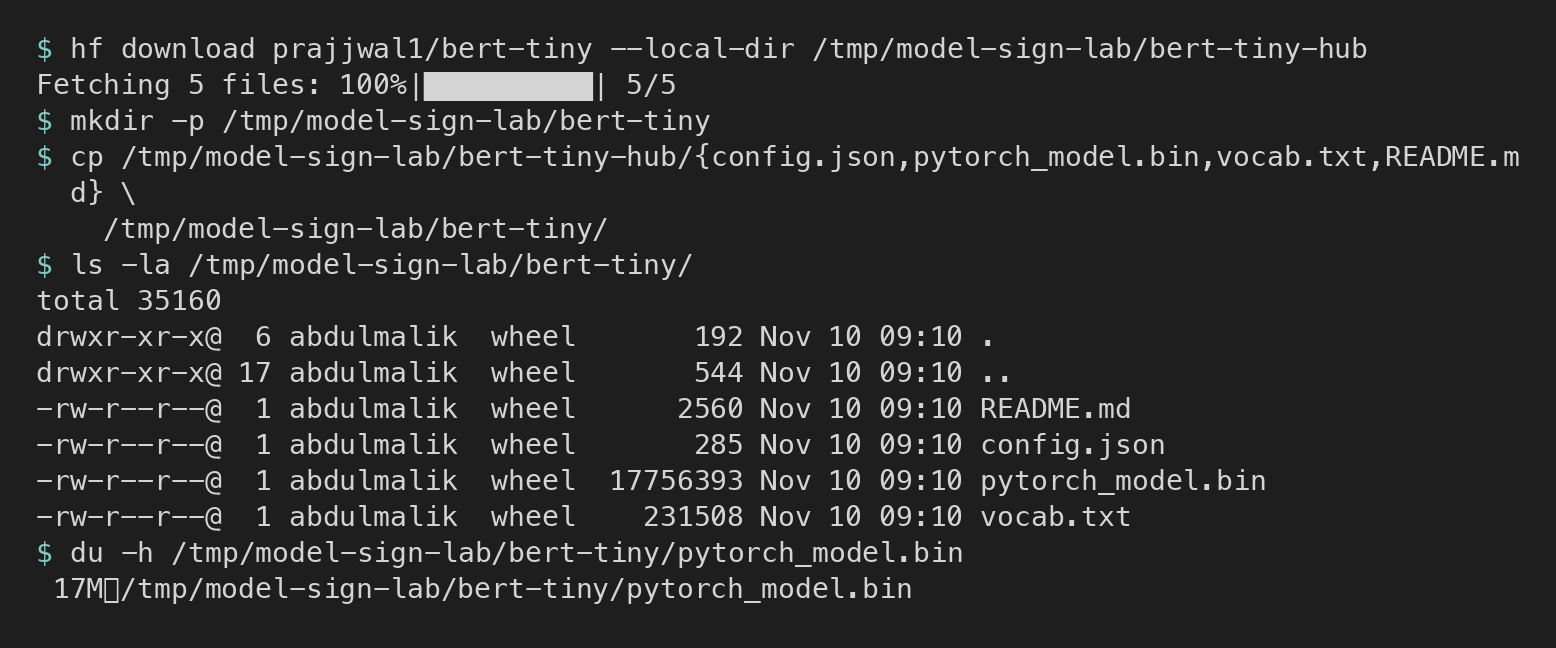
Hub pull of prajjwal1/bert-tiny. Clean tree under /tmp/model-sign-lab/bert-tiny with a 17MB pytorch_model.bin.
2. Sign with a key pair
CLI flags on model-signing 1.1.1 use underscores: --private_key, --public_key. By default git-related paths are ignored (--ignore-git-paths).
$ cd /tmp/model-sign-lab
$ source /tmp/model-signing-venv/bin/activate
$ openssl ecparam -name prime256v1 -genkey -noout -out key.priv
$ openssl ec -in key.priv -pubout -out key.pub
$ model_signing sign key bert-tiny \
  --private_key key.priv \
  --signature bert-tiny.sig
Signing succeeded
bert-tiny.sig is a Sigstore-style bundle (~2KB) wrapping a DSSE / in-toto statement over the hashed model files.
3. Verify success
$ model_signing verify key bert-tiny \
  --signature bert-tiny.sig \
  --public_key key.pub
Verification succeeded
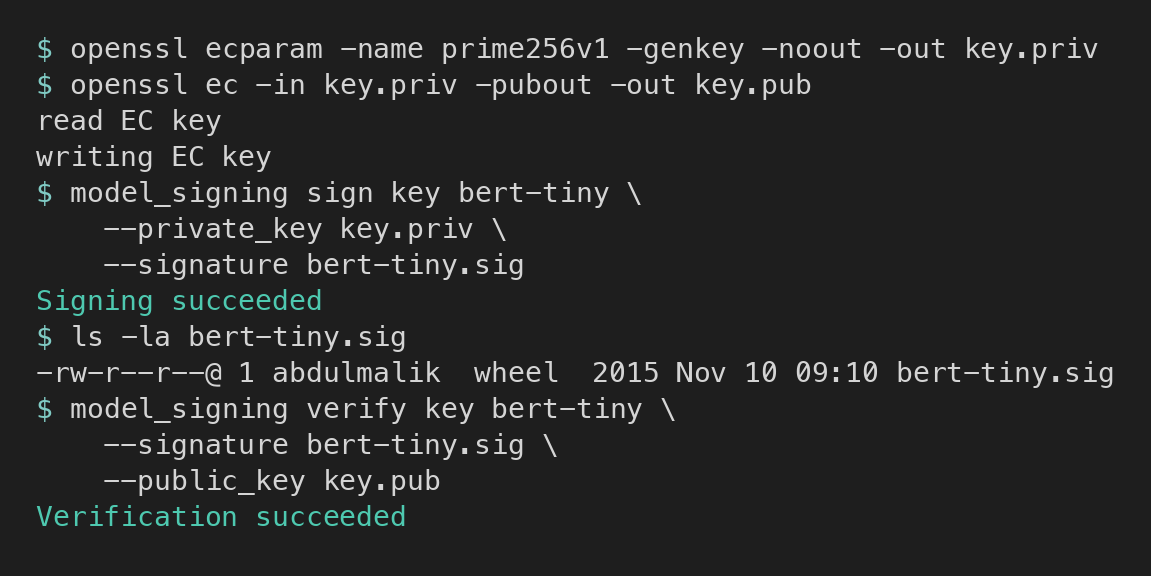
Sign the directory, list the .sig, verify with the public key.
4. Bitflip a weight byte, watch verify fail
$ chmod u+w bert-tiny/pytorch_model.bin
$ printf X | dd of=bert-tiny/pytorch_model.bin bs=1 seek=0 conv=notrunc status=none
$ model_signing verify key bert-tiny \
  --signature bert-tiny.sig \
  --public_key key.pub
$ echo "exit=$?"
exit=1
Non-zero exit. Hash mismatch on pytorch_model.bin.
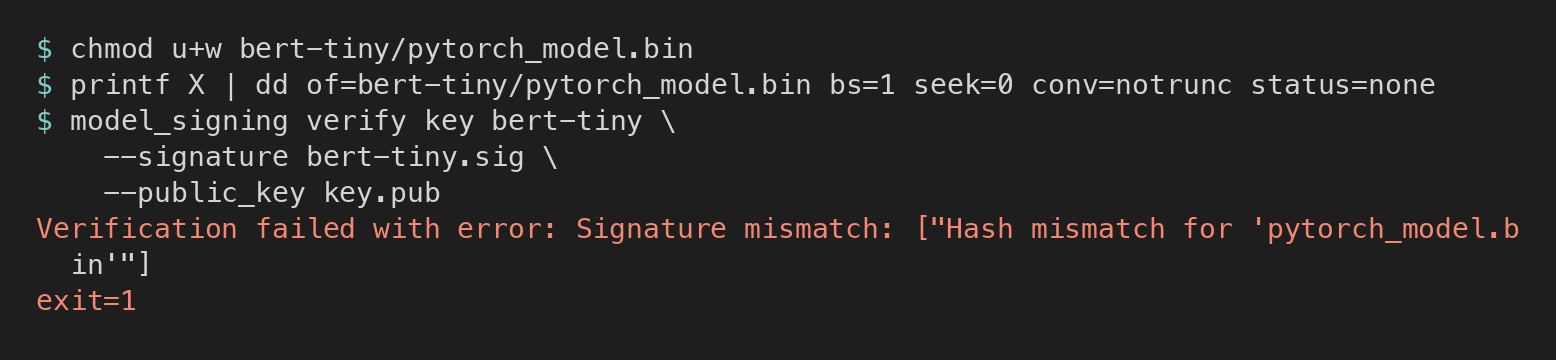
Same signature, tampered weights: hash mismatch for pytorch_model.bin.
Restore before you continue:
$ cp bert-tiny-hub/pytorch_model.bin bert-tiny/pytorch_model.bin
$ chmod u+w bert-tiny/pytorch_model.bin
$ model_signing verify key bert-tiny \
  --signature bert-tiny.sig \
  --public_key key.pub
5. Same habit with Cosign on a file-hash list
Cosign already signs blobs. Hash the model files into hashes.txt, sign that blob, verify, then flip one byte. This is still signing integrity, not an SBOM.
$ cd /tmp/model-sign-lab
$ cp bert-tiny-hub/pytorch_model.bin bert-tiny/pytorch_model.bin
$ chmod u+w bert-tiny/pytorch_model.bin
$ (cd bert-tiny && find . -type f | sort | while read -r f; do
  shasum -a 256 "$f"
done) > hashes.txt
$ COSIGN_PASSWORD=demo cosign generate-key-pair --output-key-prefix labcosign
$ COSIGN_PASSWORD=demo cosign sign-blob \
  --key labcosign.key \
  --bundle hashes.sigbundle \
  hashes.txt
$ cosign verify-blob \
  --key labcosign.pub \
  --bundle hashes.sigbundle \
  hashes.txt
Verified OK
$ printf X >> hashes.txt
$ cosign verify-blob \
  --key labcosign.pub \
  --bundle hashes.sigbundle \
  hashes.txt || true
Verified OK on the honest hash list. Invalid signature after the append.
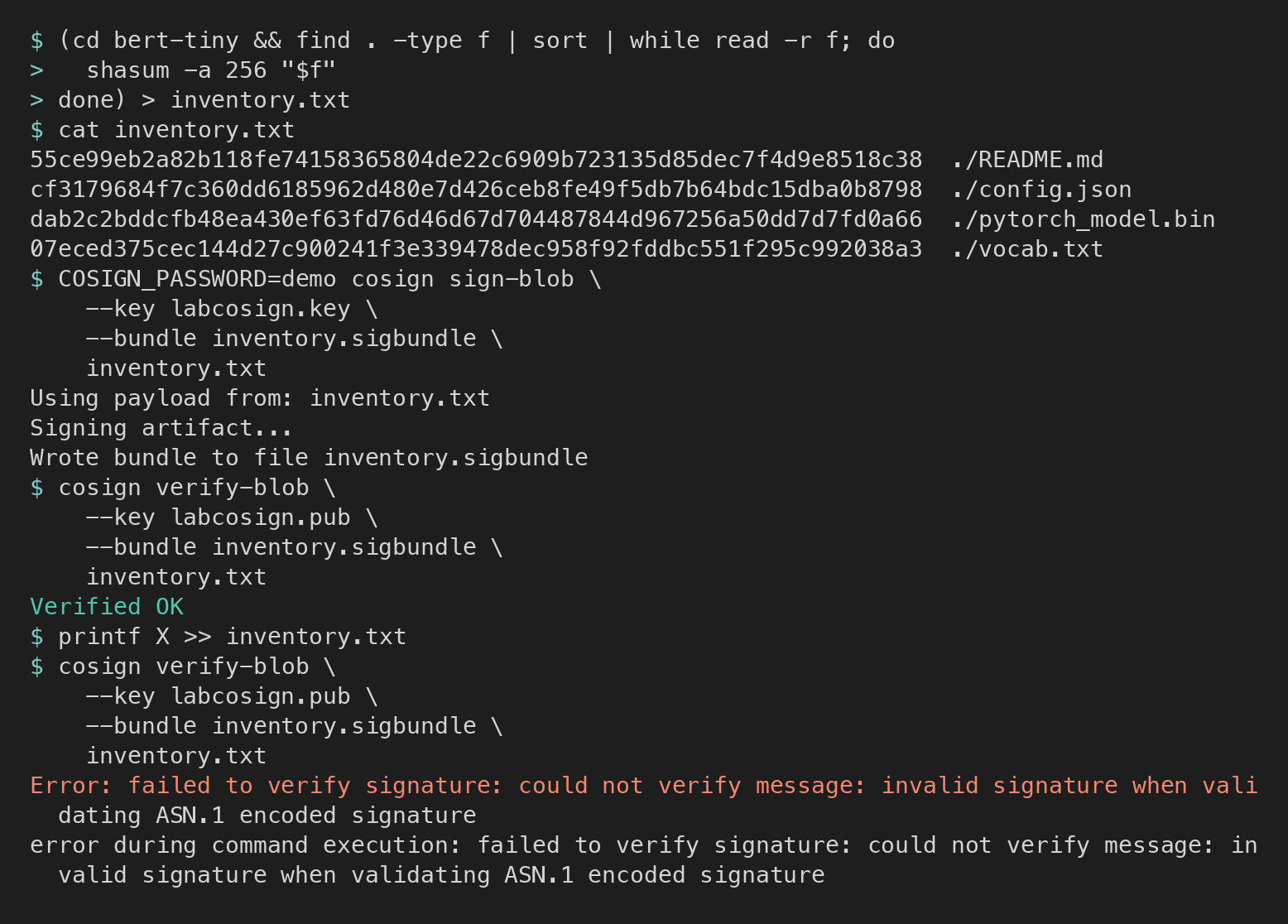
Cosign on the model hash list: verify succeeds, then fails after the payload flips.
6. Verify against a pinned identity, at every boundary
A valid signature proves authenticity of the hashed files and possession of the key (or OIDC identity). It does not prove the model is benign. A publisher can sign a backdoored pack.
Signing is only as strong as the identity policy. Verifying against "any signer from this org" is nearly worthless. Pin the expected releaser identity and issuer. Keep the issuer in config, not hard-coded. For GitHub Actions it is https://token.actions.githubusercontent.com. The identity is the signing workflow URI pinned to a git ref.
Check signatures where the artifact crosses a boundary: upload, select for deploy, consume as input to another model. A signature checked once at download and never again does not protect tampering in your own conversion pipeline.
Prefer safetensors even after verify, so a verification gap is not also an RCE.
Build, sign, and promote in GitHub Actions
Local key signing is the hash check. Production still needs what you already do for containers: package in CI, sign it, do not promote when verify fails.
Training often lives on a GPU cluster. Actions should own package + sign + promote. Swap the stage step for "fetch the checkpoint your trainer just wrote" when you wire this for real.
Marketplace pieces you can install, then shell for the rest:
- KitOps CLI:
jozu-ai/gh-kit-setup. Still shellkit pack/kit push. - Cosign keyless:
sigstore/cosign-installer@v4.1.3. Still shellcosign sign/cosign verifywith a pinned identity. - Registry login:
docker/login-action(GHCR). Auth needs no extra shell. - Stage checkpoint: no official Hub-snapshot Action for this shape. Shell
hf download, or copy from your trainer. - OpenSSF
model-signing: no official Action yet. CLI-first. Pinpip install model-signing==…and run the CLI.
Permissions match the Cosign keyless post: id-token: write for Fulcio, contents: read for checkout, packages: write when you push to GHCR.
KitOps + Cosign keyless (OCI admit path)
KitOps ModelKits are OCI 1.1 artifacts. Same Cosign flow as images. Use this when promote already means an OCI ref in the registry.
name: build-sign-promote-model
on:
  workflow_dispatch:

env:
  MODEL_REF: ghcr.io/${{ github.repository }}/bert-tiny:ci
  # Pin the workflow URI Fulcio embeds. Same idea as containers.
  EXPECTED_IDENTITY: https://github.com/${{ github.repository }}/.github/workflows/build-sign-promote-model.yml@refs/heads/${{ github.ref_name }}

jobs:
  build-and-sign:
    runs-on: ubuntu-latest
    permissions:
      id-token: write
      contents: read
      packages: write
    steps:
      - uses: actions/checkout@v4

      - uses: actions/setup-python@v5
        with:
          python-version: "3.11"

      - name: Stage sample model (or copy your trainer checkpoint)
        run: |
          pip install "huggingface_hub"
          mkdir -p model/hub model/bert-tiny
          hf download prajjwal1/bert-tiny --local-dir model/hub
          cp model/hub/{config.json,pytorch_model.bin,vocab.txt,README.md} model/bert-tiny/
          # If the runtime loads prompt.txt / tools.json with the weights,
          # copy them into model/bert-tiny/ here so they enter the signed ModelKit.

      - name: Kitfile
        run: |
          cat > Kitfile <<'EOF'
          manifestVersion: 1.0.0
          package:
            name: bert-tiny
            version: 0.0.1
          model:
            name: bert-tiny
            path: ./model/bert-tiny
            framework: pytorch
          EOF

      - uses: jozu-ai/gh-kit-setup@v1.0.0
      - uses: docker/login-action@v3
        with:
          registry: ghcr.io
          username: ${{ github.actor }}
          password: ${{ secrets.GITHUB_TOKEN }}
      - uses: sigstore/cosign-installer@v4.1.3

      - name: Pack, push, keyless sign
        run: |
          kit pack . -t "${MODEL_REF}"
          kit push "${MODEL_REF}"
          cosign sign --yes "${MODEL_REF}"

  promote-and-serve:
    runs-on: ubuntu-latest
    needs: build-and-sign
    permissions:
      contents: read
      packages: read
    steps:
      - uses: sigstore/cosign-installer@v4.1.3
      - name: Verify with pinned OIDC identity
        env:
          MODEL_REF: ${{ env.MODEL_REF }}
          EXPECTED_IDENTITY: ${{ env.EXPECTED_IDENTITY }}
        run: |
          cosign verify \
            --certificate-identity "${EXPECTED_IDENTITY}" \
            --certificate-oidc-issuer "https://token.actions.githubusercontent.com" \
            "${MODEL_REF}"
          echo "promote/serve gate passed"
          # kit unpack / deploy only after verify succeeds
Paste this workflow, hit Run workflow, confirm both jobs green before you trust the copy-paste.
OpenSSF model-signing (directory from disk)
Use this when the serve gate loads a directory from disk. No official marketplace Action yet, so install is one pinned pip step.
# jobs.build-and-sign / promote-and-serve shape, artifact-based
permissions:
  id-token: write   # sign job only
  contents: read

steps:
  - uses: actions/checkout@v4
  - uses: actions/setup-python@v5
    with:
      python-version: "3.11"
  - run: pip install "model-signing==1.1.1" pyOpenSSL "huggingface_hub"
  - run: |
      mkdir -p artifacts/hub artifacts/bert-tiny
      hf download prajjwal1/bert-tiny --local-dir artifacts/hub
      cp artifacts/hub/{config.json,pytorch_model.bin,vocab.txt,README.md} artifacts/bert-tiny/
  - run: |
      model_signing sign sigstore artifacts/bert-tiny \
        --signature artifacts/bert-tiny.sig \
        --use_ambient_credentials
  - uses: actions/upload-artifact@v4
    with:
      name: bert-tiny-signed
      path: |
        artifacts/bert-tiny
        artifacts/bert-tiny.sig

# promote job: download-artifact, same pip pin, then:
# model_signing verify sigstore artifacts/bert-tiny \
#   --signature artifacts/bert-tiny.sig \
#   --identity "${EXPECTED_IDENTITY}" \
#   --identity_provider "https://token.actions.githubusercontent.com"
CLI flags on model-signing 1.1.1 (underscores):
- Sign:
model_signing sign sigstore <dir> --signature <bundle> --use_ambient_credentials - Verify:
model_signing verify sigstore <dir> --signature <bundle> --identity <workflow URI> --identity_provider https://token.actions.githubusercontent.com
Pin the workflow file path and ref you trust. Do not accept "any signature from this repo."
Offline verify after you download the artifact:
$ model_signing verify sigstore ./bert-tiny \
  --signature ./bert-tiny.sig \
  --identity "https://github.com/OWNER/REPO/.github/workflows/build-sign-promote-model.yml@refs/heads/main" \
  --identity_provider "https://token.actions.githubusercontent.com"
Use Cosign on a ModelKit when admit is already "verify this OCI reference." Use model_signing when admit is "verify this directory the runtime loads."
Provenance: trusting the process, not just the publisher
Signing authenticates the artifact. Provenance authenticates how it was built. For models trained or fine-tuned in GitHub Actions, provenance is one workflow step and one verify command. GitHub artifact attestations give you SLSA Build L2-shaped provenance on hosted runners.
Lineage on a Hub model card (base_model, datasets) is the uploader's claim. It becomes evidence when each parent checkpoint appears by digest in resolvedDependencies of a signed attestation. Until then, treat pedigree and model-card base links as claims.
Attest the export in the same job
Build in CI, not on a laptop, if you want hosted-platform provenance. Attest the exported files. actions/attest generates SLSA build provenance by default. subject-path accepts a glob.
permissions:
  id-token: write
  contents: read
  attestations: write
steps:
  # ... checkout, fetch pinned base model and data, train or export ...
  - name: Attest model build provenance
    uses: actions/attest@v4
    with:
      subject-path: 'out/model/*'
  # Sign the same directory in this job so consumers pin the workflow, not a person.
Verify before promote
$ gh attestation verify out/model/model.safetensors \
  --repo my-org/model-training \
  --signer-workflow my-org/model-training/.github/workflows/train.yml
--signer-workflow stops other workflows in the org from producing an acceptable attestation. --deny-self-hosted-runners rejects self-hosted builds. GPU training often runs on self-hosted machines, so that fleet is part of what you trust.
Log verified digests, signer identity, and the attestation reference with each deployment. When production misbehaves, you want the served pack tied to a build record.
Provenance does not prove the training data was clean. It proves which builder, inputs, and subjects the platform attested. Keep that limit honest.
Putting the layers together
No single control is enough. A practical promote / load path stacks in this order:
- Format hygiene. Prefer
safetensors. Treattrust_remote_code=Trueas a privileged review, not a convenience flag. - Scanning. Run picklescan / ModelScan / commercial as a fast filter. Remember nullifAI: scanners inspect attacker-controlled content and can be evaded.
- Signature verify at every boundary. Pin identity + issuer. Fail closed before the deserializer runs. This post.
- Provenance. Require SLSA-style attest for artifacts you produce (
actions/attest+gh attestation verify). Prefer upstream that ships it. - Isolation. Load and run with least privilege and no outbound network by default, so a verification gap or a signed-but-backdoored model has a small blast radius.
Cheap filters first. Cryptographic verify before you touch the bytes. Isolation as the assume-failure backstop.
If prompts, tool manifests, or MCP configs travel with the model, put them in the signed pack before promote. Same fail-closed habit as the weight bitflip.
Inventory (SBOM / ML-BOM) is optional and adjacent if you want a bill of materials next to the signature. It is not required to sign. If you do keep one, do not sign sbom.json as the integrity control. Sign the pack. I wrote that up separately in SBOM for models.
Troubleshooting
No module named 'OpenSSL':pip install pyOpenSSLinside the venv.No such option '--private-key': use--private_key/--public_key(underscores) on 1.1.1.dd: ... Permission deniedon weights: Hub files can be444;chmod u+wfirst.- Verify fails after you "only" edited docs: if the file is under the model path, it is in the manifest.
- Signature polluted by Hub
.cache/: copy model files into a clean dir beforesign. - Sigstore keyless wants a browser: use
sign key/verify keylocally; save OIDC for CI. - GHA sign hangs on OIDC: missing
permissions.id-token: write, or omit--use_ambient_credentials/ Cosign keyless OIDC perm. - Verify fails on identity mismatch: pin the exact workflow URI (file path +
@refs/...). - Kit / Cosign unpack fails: verify the same tag/digest you pushed.
When the next model ships, what actually refuses to run if the signed digests are wrong: the slide, or the gate?